Sunday, 24 April 2011

Why I went to church today

"Hallelujah, hallelujah, Christ the Lord is risen." These words ring in my ears and from my voice. Why am I singing them? Because I am in a church on Easter Sunday. Why am I singing them when I have no belief in Christ, the Lord or the resurrection? Because I am taking part in a cultural event that has been celebrated by my family for the whole of my life. And, indeed, much longer than that.

I was thirteen when I marched downstairs one Sunday morning and presented my mother with a list of reasons why I didn't believe in God. She read them, offered a few standard placations, and never forced me go to church again (though she often pleaded). A small pivot in my evolution from child to adult. After that, I went to church only for religious holidays and too many funerals, but stayed mute for anything other than the hymns, and even then my churlish teenage mind refused to sing any words relating to the Holy Trinity.

But now I'm back and I'm singing my heart out. The reasons are many but mainly this: I am precisely twice thirteen years old, but the amount I've matured has far more than doubled. I've considered my family's religion and I've realised that the worth in normal, everyday Christianity is community. Going to church and singing about God does not betray my atheist beliefs, it does not bring me closer to Him but it does bring me closer to my family.
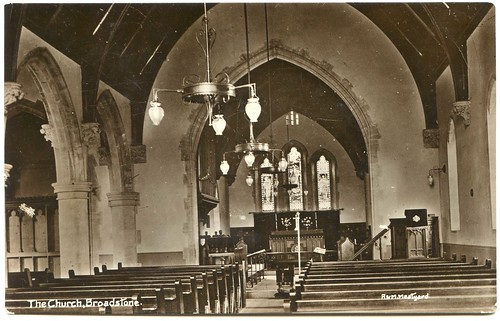
St John's Church, Broadstone, Dorset
My parent's local church: St John's, Broadstone, Dorset. Real photo postcard by R & M Meatyard (date unknown). From alwyn_ladell on Flickr.

In a BHA survey last year, fewer than half the respondents who identified as Christian said they believed Jesus Christ was a real person who died, came back to life and was the son of God. Indeed my father, who goes to church every Sunday, confessed to me five years ago that he does not believe Jesus is the son of God. There are many similarly-minded people who go to church simply to meet other people, to enjoy a shared experience, or just as part of routine. We are creatures of habit, and sometimes the loss of something that has been with you all your life is too painful to bear. So Dad goes with Mum (who is less enlightened than he) every week to a beautiful building to sing and praise the wonders of life. The difference is Mum believes God made these bright and beautiful things; Dad thinks not. Does it really matter? Church brings them together, and today I'm together with them, and they're happy I'm there.

Last week, I even went to a church on my own, of my own volition. Four years ago my Catholic brother died. To mark this, I lit a candle in his memory and wrote him a song lyric in a book for prayers. Churches aren't just buildings of religion, they are anchors. I spent my grief there, rather than at home, or in an art gallery, or a pub, or anywhere else he identified with because there is a tradition of lighting candles in churches and it is comforting. A place to deposit my sadness and my loss, and then leave.

The words of Martin Rees on winning the Templeton Prize struck a chord with me: "[churchgoing is] a common traditional ritual which one participates in as part of one's culture." He hammers the nail right on the head.

Thursday, 10 February 2011

The comfort of a chiropractor

I wrote this last year while recovering from a week-long illness. I decided not to publish it then. But due to the recent spate of posts along the lines of "don't call me stupid", exploring why some people might be drawn to alternative medicine, I thought it was timely to post about my experience at the hands of a chiropractor.

I've been ill for a week, so my thoughts have naturally wandered to medicine. My drug of choice has been giant chocolate buttons. Not strictly a medicine, but the bright purple packaging, the crack of each button in my crunching teeth and the sweet sugar rush is so comforting. This reminds me of chiropractic: a questionable treatment, but in my experience, a big comfort.
I was thirteen years old and training for a major ballet exam when I tore my left hamstring. Six months later, I tore the right. Scar tissue formed, the tight muscles resulted in chronic back pain. My dad took me to local chiropractor and family friend, Beth, who had treated his bad back.

Who loves the feeling of making their knuckles pop? This is what spinal adjustment, the technique chiropractors employ, feels like. This kind of immediate relief is very important for a teenager whose dreams of being a ballet dancer have just been ripped apart.
I had no idea that chiropractic was founded on pseudo-science. Why would I? I grew up in a typical Daily Mail household where little was questioned. And would I have cared? Probably not. After weekly sessions of adjustment, massage and ultrasound treatment, I could dance again.

It was possibly, and probably, the more standard techniques of deep tissue massage and ultrasound that healed my aching body. A physio at the nearest hospital could have treated me in the same way. But Beth was a family friend and known in my local community. When my dad took me to a practitioner who had helped him, I felt cared for. My Dad was looking after me. During my sessions with Beth, I chatted about my university plans and she even helped me choose what to study.

Personal recommendation, community spirit and desperation are all reasons why people, including myself, have gone to see the chiropractor. Not because they are stupid, defiant, or even ignorant. Because sometimes it's just where they end up, steered by family, friends and promises. And when those promises turn out to be true, when the treatment seems to work, then the cycle continues.

Thursday, 27 January 2011

Undiluted spirit

Last night I claimed that whisky was the most scientific drink, "ever". This superlative was uttered with little evidence, like many claims made under the influence of alcohol. But there is some fascinating science behind the making and drinking of my favourite tipple. I rambled a little about the different flavour molecules that give whisky its rich and smoky taste. The fine words below, written by Andy Connelly for the Guardian, explain very well what I was trying to say:

The chemicals that are reaching your nose are a complex mixture, the culmination of distillation and years maturation. But they are not a fixed set, you can still alter and change the bouquet that greets your nose and so the flavour of the whisky simply by adding water. Adding water to whisky changes the concentration of alcohol and so increases the volatility of alcohol-soluble hydrophobic or long-chain compounds such as the fruity esters, increasing the fruity aspects of the whisky's flavour.

In contrast, smoky phenolics and roasted nut and cereal-flavoured nitrogen-containing compounds are water-soluble, and the volatility of these is reduced with water addition and so the smoky aspect of the whisky's flavour is reduced. However, the addition of ice reduces the temperature of the whisky and hence reduces the volatility of all the compounds, leading to a reduced aroma and a diminished taste.

Which is why you should never, never add ice to your single malt.

I've just bought an eye-watering Bruichladdich single cask whisky. Single cask means the whisky has come straight from the cask it's matured in, and not mixed with anything. This whisky is undiluted, so it's a whacking 66% alcohol. The whisky you buy in the shops or most bars is always watered down to make it more palatable to the average imbiber. It's ready-diluted, at around 40%. The beauty of my whisky (from the Scotch Malt Whisky Society) is that I can water down the neat spirit to suit my tastes, releasing those delicious flavour molecules as I wish. Or not, if I'm feeling particularly masochistic.

Cheers!

Wednesday, 26 January 2011

From Then On

My brother wrote this. It seems fitting, now.

From then on
It’ll always be different.
Quite apart from the pain
And the grief
And her room unchanged,
In the street
They’ll always be different;
From then on.

From then on
They’ll wonder at death,
But you’ll know.
They’ll ask you round;
If you don’t want to go,
Understand,
But still wonder at death;
From then on.

From then on
You’ll wish you could scream.
You carry emotions
From room to room
And they have small notion
Of gloom.
Every day’s a bad dream
From then on.

Paul Maddocks
26 January 1969 – 19 April 2007

Saturday, 20 November 2010

Update

I haven't written much on this blog. But I have been writing other things, for other blogs. So rather than leave this bare, I thought I'd put up links to my posts elsewhere.

First thing I'll link to is the most personal piece I've written. It's about the tattoo on my back, and why I had it done. The post was written for Wellcome Collection, because they used a photograph of my tattoo to advertise one of their Skin exhibition events.

Click on the photograph to read more.

Monday, 19 July 2010

Upping your knowledge about swans

My brother's second favourite joke is to list five facts about swans:

1. They all belong to The Queen
2. They mate for life
3. They can break your arm with a single blow from their wing
4. They only make noise when they're dying
5. There are only five facts about swans.

Hilarious. My love of swans extends to having one tattooed on my back, and I'd like to set the record straight, because none of these facts are true.

Under Royal Prerogative, the Monarch owns all wild mute swans living in open water - not all swans, just the ones you would immediately think of if someone asked you to picture a swan. Curved neck with a black knob atop.


Realistically, the Queen only exercises her ownership rights on some stretches of the Thames and its tributaries; Bewick's and Whooper swans are exempt; as are any marked by the Vintners' and Dyers' Livery Companies, which were granted their rights of ownership by the Crown in the fifteenth century.

The marking of swans along the Thames is carried out every July, in a week-long census called the Swan Upping. This year, the census starts today.

As romantic a notion it is, swans don't mate for life. A mating pair are monogamous, form a strong bond, and work together to rear their cygnets, but pairs do sometimes "divorce", and if one of the pair dies, the other will sometimes find a new mate after a period of grieving.


The myth of the dying swan has inspired art: the poem, and in turn, the ballet. As for making no noise, well, Whooper swans are named after their loud, honking call. Likewise, mute swans earned their moniker with their silence. But you will hear a mute swan coming from the vibrant throbbing of its wings in flight, and prepare for plenty of hissing, snorting and grunting if you get too close to one of its babies.


Swans are fiercely protective of their young. They will act aggressively if their family of cygnets is threatened. But they can't break your arm with their wing. Birds can fly because their bones are full of hollows, making them very light. Human bones are much more dense, so unless you're suffering from osteoporosis (which results in bones having a honeycomb structure similar to that of a bird's) a swan is much more likely to break its wing with your arm, rather than the other way round.

The fifth fact about swans is that there are five true facts and more to read at the British Waterways' website, Waterscape.


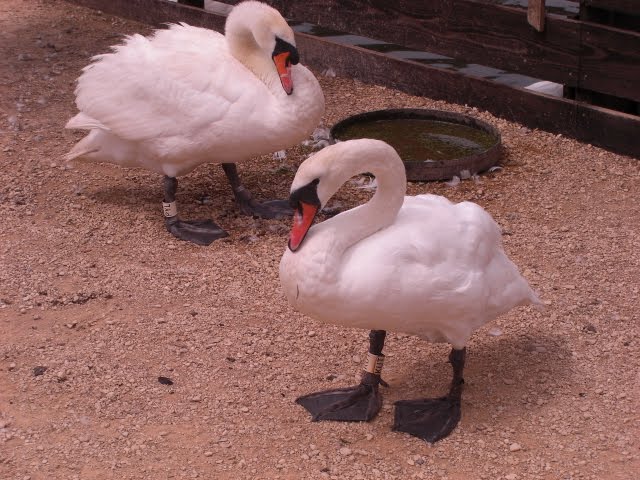
All photos from my recent visit to Abbotsbury Swannery in Dorset, the largest colony of swans in the UK and the only place where I can be persuaded to spend two hours outdoors on a very hot summer's day.

Friday, 9 July 2010

RIP Alfred Russel Wallace

I bear a passing resemblance to a vampire. Pale, dark hair, shuns the Sun. So on a very hot July day in my Dorset hometown, (super)naturally, I went to a visit a dead man in a graveyard.

Alfred Russel Wallace died in Broadstone in 1913 and was buried in the local cemetery. His contribution to science is, in my opinion, under-recognised and undervalued. He devised the same theory of evolution as Charles Darwin and the letters sent by Wallace explaining this to him spurred the older man to publish his long-ruminated account, On The Origin of Species, in 1859.

Darwin's book followed a presentation on July 1st 1858 of both accounts of the theory of evolution by natural selection to the Linnaen Society, and although a letter accompanying the papers indicated Darwin's priority, Charles Lyell and Joseph Hooker stated, "both men deserve ample recognition."

Where is this recognition today? Darwin's face graces the English £10 note. He is interred in Westminster Abbey. Yet this monument to Wallace at his burial site was erected only in 2000 by the A. R. Wallace Memorial Fund. Well, I've written an essay on the topic, but suffice to say, Wallace's divergent views, his conversion to spiritualism and his anti-vaccinationist stance made him unpopular in his later years.

Broadstone remembers him. My parents nearly bought a house on this road - metres from where Wallace, the "grand old man of science", spent his last days. Rest in peace Alfred, and know that although spirits don't exist, vampires are visiting your grave.