The many nightmares seem to have ended and by day
I am awaking from one long, hazy dream. I am going
backwards as the world thrusts forward, or so it seems;
but we are both wrong and only one of us is doing
anything to try and correct. On I go; or back.
...and it is here that I feel most truly alive,
back, back amongst the dead. For I was dead
once and yet to be, now living I am yet to be dead,
feeling so longing once more for life.
For even in the fields of the romances of both faint and flint-
hearted middle classes are their children growing
into desolation - nought to haven't, no food for
their minds, their souls withering.
Paul Maddocks
26 January 1969 - 19 April 2007
Wednesday, 25 January 2012

Sunday, 22 January 2012
Present, tense
Oh poor he
that imbibes
pills, whisky
and survives.
Awakes in
unknown place,
gleaming white,
not heaven
but hell; race
through all thoughts
not dispelled.
Attempt to
end them all,
die, has failed.
Nurse glowers,
doctor rails.
Present tense,
past gone, no
future nailed.
Paul Maddocks
(1969-2007)
that imbibes
pills, whisky
and survives.
Awakes in
unknown place,
gleaming white,
not heaven
but hell; race
through all thoughts
not dispelled.
Attempt to
end them all,
die, has failed.
Nurse glowers,
doctor rails.
Present tense,
past gone, no
future nailed.
Paul Maddocks
(1969-2007)
Wednesday, 18 January 2012
Nick Drake
Wikipedia is down, in protest against SOPA. Out of curiosity, I checked the app version on my phone, and it's still up. Their featured article of the day is about the tragic singer Nick Drake. Drake is one of those musical interests I picked up in my late teenage years, listened to obsessively and then dropped as I moved on to the next auditory addiction. So my interest was piqued.
I started reading about him and coincidence compelled me to read more. Drake killed himself aged 26. I am 26. Nothing in that really but just a chime. Drake killed himself with an overdose of amitriptyline - unknown to be accidental or otherwise. I dose myself with amitriptyline - though in my case, not for crippling depression but to prevent searing headaches and unbearable back pain.
But what struck me is the quote from Drake's sister about his death because it echoes so much what I feel about my brother's death, which was ruled an open verdict rather than suicide because the coroner could not determine if he intended to end his life or whether it was a horrible misjudgement:
"I'd rather he died because he wanted to end it than it to be the result of a tragic mistake. That would seem to be terrible..."
I'd rather Paul intended to die than had his life snatched away from him by a mistake. It just doesn't seem fair. But nothing is fair about what happened. I'll never know and that's something I have to live with.

I started reading about him and coincidence compelled me to read more. Drake killed himself aged 26. I am 26. Nothing in that really but just a chime. Drake killed himself with an overdose of amitriptyline - unknown to be accidental or otherwise. I dose myself with amitriptyline - though in my case, not for crippling depression but to prevent searing headaches and unbearable back pain.
But what struck me is the quote from Drake's sister about his death because it echoes so much what I feel about my brother's death, which was ruled an open verdict rather than suicide because the coroner could not determine if he intended to end his life or whether it was a horrible misjudgement:
"I'd rather he died because he wanted to end it than it to be the result of a tragic mistake. That would seem to be terrible..."
I'd rather Paul intended to die than had his life snatched away from him by a mistake. It just doesn't seem fair. But nothing is fair about what happened. I'll never know and that's something I have to live with.

Nick Drake's grave in Solihull, West Midlands. By Robpics69 on Wikipedia.
Monday, 2 January 2012
The Campaign Against Living Miserably
Suicide is the leading cause of death in men under 35 in recent years. Men are nearly three times more likely than women to take their own life. In men under 35, suicide is the second most common cause of death in England and Wales. In Scotland, more men between the ages of 15-35 kill themselves than die from any other cause.
I wish this wasn't the case. I wish that no one wanted to kill themselves. I wish my brother hadn't killed himself.
But life isn't like that. It's hard and it's unfair and some people are so stricken by mental health problems that death seems like the only possible way to cope. We must, together, look after these people and help them find a way out of the worst despair you can't imagine. We have to stop 4,500 people killing themselves (in just England and Wales) every year.
The Campaign Against Living Miserably, CALM, is a lifeline for people who desperately need this help. Originally set up to reduce the high suicide rate amongst young men, they run a free, confidential, anonymous helpline for anybody who needs advice or support. The helpline is open 5pm-midnight from Saturday to Tuesday. But it's not enough. CALM want to run the helpline every day of the week until 3am, but they can't. They are scraping together every penny to cover the existing monthly running costs of £6,400.
This is why Science Showoff, a gig I help to organise, is going to give CALM all its donations in January. The gig is on 12th January at the Wilmington Arms in Clerkenwell, London. Please come along and please, please give generously. We have to help stop the tragedy of suicide.
I wish this wasn't the case. I wish that no one wanted to kill themselves. I wish my brother hadn't killed himself.
But life isn't like that. It's hard and it's unfair and some people are so stricken by mental health problems that death seems like the only possible way to cope. We must, together, look after these people and help them find a way out of the worst despair you can't imagine. We have to stop 4,500 people killing themselves (in just England and Wales) every year.
The Campaign Against Living Miserably, CALM, is a lifeline for people who desperately need this help. Originally set up to reduce the high suicide rate amongst young men, they run a free, confidential, anonymous helpline for anybody who needs advice or support. The helpline is open 5pm-midnight from Saturday to Tuesday. But it's not enough. CALM want to run the helpline every day of the week until 3am, but they can't. They are scraping together every penny to cover the existing monthly running costs of £6,400.
This is why Science Showoff, a gig I help to organise, is going to give CALM all its donations in January. The gig is on 12th January at the Wilmington Arms in Clerkenwell, London. Please come along and please, please give generously. We have to help stop the tragedy of suicide.
Wednesday, 19 October 2011
The science of whisky
I entered the piece below into the Wellcome Trust Science Writing Prize. It didn't quite make the shortlist, but I'm really proud of it and wanted to share it with more than the two shortlisters who read it for the competition. I hope you enjoy reading it as much as I enjoyed writing it.
You would not expect the scent of whisky to waft from a chemistry lab. You certainly wouldn’t hope to smell it around working scientists. But with 300 detectable chemical compounds, whisky is more complex than human blood. It is made by the standard scientific technique of distillation and it has a very scientific life.
This life begins as a simple beer. To make whisky, first, malt some barley. Next, add yeast, and let it devour the sugars released by the malted barley. This sweet fuel is energy for the yeast to produce alcohol by fermentation. Together, the alcohol, yeast and sticky barley form the beery “wash”.
Scottish monks were making whisky in the 12th century, by condensing the vapours of boiled “wash” to drink. This distilled spirit was named uisge beatha, the water of life. It was clear like vodka, twice as strong, and drunk without adulteration. Darren Rook of http://thewhiskyguy.co.uk explains, “The Scottish monks learned the method of whisky making from European counterparts who called the spirit aqua vitae – a little like scientists share their methods today.”
In the 18th century someone discovered something magical: if you pour this strong, clear, distilled alcohol into a large barrel and leave it a while, you will discover an amber, smooth drink that seems to cleanse the soul. Now, with modern techniques of mass spectrometry and chromatography, scientists can explain the magic that makes the whisky we know.
Some chemical compounds sneak in at birth. The first stage of whisky-making, malting, requires fire to dry the barley. Peat is one fuel for this fire, and peat contains phenols. These aromatic hydrocarbons produce the rich, smoky flavours of whiskies made in peat-fired distilleries like those on the small Scottish island of Islay. When you sip an Islay whisky, you can almost feel the peaty smoke fill your mouth.
Distilling adds chemical fire to the wash. It captures the strong, burning ethanol, but also the buttery diketone, diacetyl, and the fruity acetals. Distillation also produces fusel oils. In small quantities, these higher-order, oily alcohols round out a whisky, giving it body. In excess, fusel oils are toxic. The stillman who brings the whisky through this adolescence is a Goldilocks figure, cutting off the distillation at precisely the point where the concentration of fusel oils is just right.
And so we have a teenage spirit, grown up from its babyish beginnings in a warm bath. What our 12th century monks did not know is that uisge beatha is not the end game. Place the young spirit in a wooden womb and something really comes to life. After three years or more in an oak cask, the water of life is reborn.
“We do not know exactly what happens in the cask, it is still a mystery that science is yet to fully understand,” says Professor Paul Hughes, Director of the International Centre for Brewing & Distilling, Edinburgh. What the Centre’s scientists do know is that chemical compounds in the oak enrich and transform the spirit.
Tannin, which makes tea brown, gives whisky its golden glow. Oak lactones also mingle in, giving a hint of sweet coconut. The carbon lining of charred whisky helps to release vanillin from the oak. The active carbon filters out undesirable substances like sulphur that cause an eggy taste. Gaps and pores in the cask’s wood let in air. Gently, gently, this air oxidises the alcohols, breathing new life into the spirit. Ethanol reacts with acids during this maturation process, giving rise to zesty esters – more commonly found in pear drops.
The final result is an aged concoction so loved worldwide that in 2010 Scotland’s whisky exports earned the UK £109 a second. That’s a staggering 1060 million bottles sold. And while the chemistry of whisky-making stops at bottling, the science is far from over. Whisky is made for tasting, not examination under the spectrometer. The human brain is possibly the most remarkable detector of all.
The moment whisky enters the mouth, our salivary glands spring into action and one little sip sloshes around ten thousand taste buds. Volatile compounds like the esters travel up the nasal passages. The brain’s olfactory and gustatory areas (for sensing smell and taste) light up. Our remarkable minds discover and describe flavours that are often unbelievable. Members of the Scotch Malt Whisky Society (SMWS) sometimes describe the taste of iodine to SMWS Ambassador Craig Johnstone, although, “there is no iodine in the whisky. But aromas are very strong triggers for memories and phenols do give an antiseptic smell to whiskies, much like iodine in old antiseptics.”
As the last traces of a whisky die from the tongue, its long and complex life ends. It is a life of evolution and metamorphosis, of meetings between chemicals with long and complicated names. But what a life.
You would not expect the scent of whisky to waft from a chemistry lab. You certainly wouldn’t hope to smell it around working scientists. But with 300 detectable chemical compounds, whisky is more complex than human blood. It is made by the standard scientific technique of distillation and it has a very scientific life.
This life begins as a simple beer. To make whisky, first, malt some barley. Next, add yeast, and let it devour the sugars released by the malted barley. This sweet fuel is energy for the yeast to produce alcohol by fermentation. Together, the alcohol, yeast and sticky barley form the beery “wash”.
Scottish monks were making whisky in the 12th century, by condensing the vapours of boiled “wash” to drink. This distilled spirit was named uisge beatha, the water of life. It was clear like vodka, twice as strong, and drunk without adulteration. Darren Rook of http://thewhiskyguy.co.uk explains, “The Scottish monks learned the method of whisky making from European counterparts who called the spirit aqua vitae – a little like scientists share their methods today.”
In the 18th century someone discovered something magical: if you pour this strong, clear, distilled alcohol into a large barrel and leave it a while, you will discover an amber, smooth drink that seems to cleanse the soul. Now, with modern techniques of mass spectrometry and chromatography, scientists can explain the magic that makes the whisky we know.
Some chemical compounds sneak in at birth. The first stage of whisky-making, malting, requires fire to dry the barley. Peat is one fuel for this fire, and peat contains phenols. These aromatic hydrocarbons produce the rich, smoky flavours of whiskies made in peat-fired distilleries like those on the small Scottish island of Islay. When you sip an Islay whisky, you can almost feel the peaty smoke fill your mouth.
Distilling adds chemical fire to the wash. It captures the strong, burning ethanol, but also the buttery diketone, diacetyl, and the fruity acetals. Distillation also produces fusel oils. In small quantities, these higher-order, oily alcohols round out a whisky, giving it body. In excess, fusel oils are toxic. The stillman who brings the whisky through this adolescence is a Goldilocks figure, cutting off the distillation at precisely the point where the concentration of fusel oils is just right.
And so we have a teenage spirit, grown up from its babyish beginnings in a warm bath. What our 12th century monks did not know is that uisge beatha is not the end game. Place the young spirit in a wooden womb and something really comes to life. After three years or more in an oak cask, the water of life is reborn.
“We do not know exactly what happens in the cask, it is still a mystery that science is yet to fully understand,” says Professor Paul Hughes, Director of the International Centre for Brewing & Distilling, Edinburgh. What the Centre’s scientists do know is that chemical compounds in the oak enrich and transform the spirit.
Tannin, which makes tea brown, gives whisky its golden glow. Oak lactones also mingle in, giving a hint of sweet coconut. The carbon lining of charred whisky helps to release vanillin from the oak. The active carbon filters out undesirable substances like sulphur that cause an eggy taste. Gaps and pores in the cask’s wood let in air. Gently, gently, this air oxidises the alcohols, breathing new life into the spirit. Ethanol reacts with acids during this maturation process, giving rise to zesty esters – more commonly found in pear drops.
The final result is an aged concoction so loved worldwide that in 2010 Scotland’s whisky exports earned the UK £109 a second. That’s a staggering 1060 million bottles sold. And while the chemistry of whisky-making stops at bottling, the science is far from over. Whisky is made for tasting, not examination under the spectrometer. The human brain is possibly the most remarkable detector of all.
The moment whisky enters the mouth, our salivary glands spring into action and one little sip sloshes around ten thousand taste buds. Volatile compounds like the esters travel up the nasal passages. The brain’s olfactory and gustatory areas (for sensing smell and taste) light up. Our remarkable minds discover and describe flavours that are often unbelievable. Members of the Scotch Malt Whisky Society (SMWS) sometimes describe the taste of iodine to SMWS Ambassador Craig Johnstone, although, “there is no iodine in the whisky. But aromas are very strong triggers for memories and phenols do give an antiseptic smell to whiskies, much like iodine in old antiseptics.”
As the last traces of a whisky die from the tongue, its long and complex life ends. It is a life of evolution and metamorphosis, of meetings between chemicals with long and complicated names. But what a life.
Sunday, 25 September 2011
The house of pain
Last night I asked a question on Twitter: is the pain from severe lower limb cramp the same as labour contractions?* This led me to ruminate on the concept of personal pain. How does anyone know that what they feel as pain is the same as what their friend, mum, partner or colleague feels?
I think I’ve experienced quite a lot of pain. I’ve had ballet teachers sit on my back to force me deeper into the splits; deep tissue massage on torn hamstrings. I’ve danced en pointe, with 40N/cm2 of force going through my toes, until they have bled. I’ve trapped a nerve in my hip and been woken up at 3am with cramp that feels like my left foot is trying to break itself in half. It once happened in the kitchen and I reached for the bread knife.
For as long as I can remember, I’ve had headaches nearly every day. Until my early teens I thought this was normal – low level pain in your head is just what happens from being alive. But once I became old enough to articulate my perceptions, I realised this frequency of pain would never be tolerated by someone who hadn’t experienced it all their life. I guess something chronic becomes normal after a while.
Once I had suffered three “ice pick” headaches age 16, I finally went to the doctor. Ice pick headaches do exactly what they say on the proverbial tin: they feel like a cruel, demented tormentor is driving an ice pick into my brain. They are excruciating, but mercifully last only three seconds (on average, for me). I reassure myself that it can’t be as painful as the contractions I might, one day, experience during labour. But I don’t know what labour feels like, so last night I asked people who do know how it compares to severe cramp, to create some sort of gauge.
But how do I know what it feels like to have an ice pick driven into my brain, really? Is what I feel as an ice pick being driven into my brain the same as what “Mike” in this case study feels? How do my ice pick headaches compare to the cluster headaches, nicknamed “suicide headaches”, that my friend Dawn endures? What is our language for comparing pain? Is it just comparing one type of pain to the other, like I tried to do on Twitter?
The Wellcome Trust-funded London Pain Consortium, which I sincerely hope has the internal name “House of Pain” and a mandatory afternoon coffee break where researchers Jump Around to escape the post-lunch slump, is looking into it. They will use hi-res fMRI and diffusion tractography imaging techniques to look at what is happening in the brain, both what it’s doing and where, during induced and existing pain. Though, rather than shoving a sharp, pointed object up someone’s nose, they will be using extract of chilli peppers to cause pain.

I should say that I’ve distilled the above explanation of their research from a rather jargon-filled summary and as I’m not a neuroscientist or the best science writer, I might not have done this very well. So two things: please correct me in the comments, and, London Pain Consortium: please put some decent public information on your website. Mun-Keat Looi wrote a feature that looks at their chronic pain research on the Wellcome Trust’s website and Barry Gibb produced this video for the same. But they shouldn’t rely on external science communicators to explain their work to a large swathe of the public (one fifth of Europeans suffer chronic pain) who are, like me, very interested to know what the House of Pain is getting down to.
*I addressed this question to “mothers” and later regretted it. I realise that women who now have children are not the only ones to have experienced labour contractions. They occur during abortion and miscarriage too. Twitter does not allow for much expansion and I wanted to address my tweet to someone to increase the chance of it being noticed and answered, but I did not mean to exclude anyone with first-hand experience of this kind of pain.
I think I’ve experienced quite a lot of pain. I’ve had ballet teachers sit on my back to force me deeper into the splits; deep tissue massage on torn hamstrings. I’ve danced en pointe, with 40N/cm2 of force going through my toes, until they have bled. I’ve trapped a nerve in my hip and been woken up at 3am with cramp that feels like my left foot is trying to break itself in half. It once happened in the kitchen and I reached for the bread knife.
For as long as I can remember, I’ve had headaches nearly every day. Until my early teens I thought this was normal – low level pain in your head is just what happens from being alive. But once I became old enough to articulate my perceptions, I realised this frequency of pain would never be tolerated by someone who hadn’t experienced it all their life. I guess something chronic becomes normal after a while.
Once I had suffered three “ice pick” headaches age 16, I finally went to the doctor. Ice pick headaches do exactly what they say on the proverbial tin: they feel like a cruel, demented tormentor is driving an ice pick into my brain. They are excruciating, but mercifully last only three seconds (on average, for me). I reassure myself that it can’t be as painful as the contractions I might, one day, experience during labour. But I don’t know what labour feels like, so last night I asked people who do know how it compares to severe cramp, to create some sort of gauge.
But how do I know what it feels like to have an ice pick driven into my brain, really? Is what I feel as an ice pick being driven into my brain the same as what “Mike” in this case study feels? How do my ice pick headaches compare to the cluster headaches, nicknamed “suicide headaches”, that my friend Dawn endures? What is our language for comparing pain? Is it just comparing one type of pain to the other, like I tried to do on Twitter?
The Wellcome Trust-funded London Pain Consortium, which I sincerely hope has the internal name “House of Pain” and a mandatory afternoon coffee break where researchers Jump Around to escape the post-lunch slump, is looking into it. They will use hi-res fMRI and diffusion tractography imaging techniques to look at what is happening in the brain, both what it’s doing and where, during induced and existing pain. Though, rather than shoving a sharp, pointed object up someone’s nose, they will be using extract of chilli peppers to cause pain.
Image of neuronal tracts in the brain created using a type of diffusion tractography called diffusion tensor imaging. Credit: Nuada Medical/Wellcome Images.
The study looking at existing pain will compare diabetic neuropathy patients: those who have pain and those who don’t. Their existing anxiety levels will be measured to see if it contributes to pain. This is especially interesting. Maybe anxiety, and maybe anxiety specifically about pain, leads to worsened personal experience of pain? This is my particular hypothesis, not theirs, but it will be interesting to see where their research goes.
I should say that I’ve distilled the above explanation of their research from a rather jargon-filled summary and as I’m not a neuroscientist or the best science writer, I might not have done this very well. So two things: please correct me in the comments, and, London Pain Consortium: please put some decent public information on your website. Mun-Keat Looi wrote a feature that looks at their chronic pain research on the Wellcome Trust’s website and Barry Gibb produced this video for the same. But they shouldn’t rely on external science communicators to explain their work to a large swathe of the public (one fifth of Europeans suffer chronic pain) who are, like me, very interested to know what the House of Pain is getting down to.
*I addressed this question to “mothers” and later regretted it. I realise that women who now have children are not the only ones to have experienced labour contractions. They occur during abortion and miscarriage too. Twitter does not allow for much expansion and I wanted to address my tweet to someone to increase the chance of it being noticed and answered, but I did not mean to exclude anyone with first-hand experience of this kind of pain.
Sunday, 7 August 2011
I Love You, Waterloo Bridge
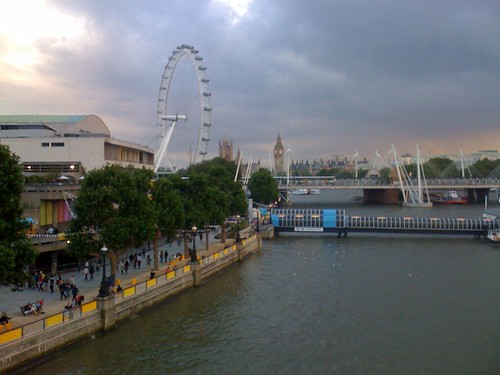
The London Eye from Waterloo Bridge, Saturday 6th August 2011, taken by me
Waterloo Bridge is the king of London bridges. Why is it masculine? I'm not really sure. But it's strong, and comforting, and it makes me feel safe. Like everything's okay. (Though maybe that's more indicative of my relationship with men.)
I moved to London for university eight years ago, and never wanted to go back to the tiny town in Dorset where I spent the first eighteen years of my life. Broadstone is sweet, and peaceful, but it's not me. I enjoy a short visit to my parents a few times a year, but when the train pulls in to Waterloo Station from its journey across the south coast, I feel a sense of relief. As my footsteps fall over Waterloo Bridge, I feel like I'm coming home. Like everything's okay.
Wendy Cope has written a poem that reflects upon this magnificent bridge better than my words can:
After The Lunch
On Waterloo Bridge where we said our goodbyes,
the weather conditions bring tears to my eyes.
I wipe them away with a black woolly glove
And try not to notice I've fallen in love
On Waterloo Bridge I am trying to think:
This is nothing. you're high on the charm and the drink.
But the juke-box inside me is playing a song
That says something different. And when was it wrong?
On Waterloo Bridge with the wind in my hair
I am tempted to skip. You're a fool. I don't care.
the head does its best but the heart is the boss-
I admit it before I am halfway across
Wendy Cope
Whenever I'm halfway across Waterloo Bridge, I snap a photo. The view from Waterloo Bridge showcases the best of London's landmarks, and it seems to change every time I cross it. These photos are not very good, but they're a chronicle of my homecoming and I hope the different moods show why I cannot get enough of the king of bridges.
Subscribe to:
Posts (Atom)